








Przegląd Gastroenterologiczny
eISSN: 1897-4317
ISSN: 1895-5770
Gastroenterology Review/Przegląd Gastroenterologiczny
Bieżący numer Archiwum Artykuły zaakceptowane O czasopiśmie Rada naukowa Bazy indeksacyjne Prenumerata Kontakt Zasady publikacji prac Opłaty publikacyjne
Panel Redakcyjny
Zgłaszanie i recenzowanie prac online
NOWOŚĆ
Portal dla gastroenterologów!
www.egastroenterologia.pl
SCImago Journal & Country Rank
1/2026
vol. 21
 
Poleć ten artykuł:
Udostępnij:
Artykuł przeglądowy

Diverticular disease increases the risk of acute myocardial infarction

Thanathip Suenghataiphorn
1
,
Pojsakorn Danpanichkul
2
,
Noppachai Siranart
3
,
Thitiphan Srikulmontri
4
,
Narathorn Kulthamrongsri
5

  1. Department of Internal Medicine, Griffin Hospital, Derby, CT, United States
  2. Department of Internal Medicine, Texas Tech University Health Science Center, Lubbock, TX, United States
  3. Faculty of Medicine, Chulalongkorn University, Thailand
  4. Department of Medicine, Albert Einstein Healthcare Network, Philadelphia, PA, United States
  5. University of Hawaii, Honolulu, HI, United States
Gastroenterology Rev 2026; 21 (1): 19–24
Data publikacji online: 2026/03/07
Pliki artykułu:
- Diverticular.pdf  [0.09 MB]
Pobierz cytowanie
 
Metryki PlumX:
 

Introduction

Diverticular disease is one of the most common conditions, in which patients with age less than 40 years comprise around 10%, and more than 70% in people in the eighth decade of life, with prevalence being similar in both men and women [1]. Over 20% of patients who had diverticulitis, one of the complications of diverticular disease, is expected to have at least one recurrence of the disease [2]. Annually in the United States, nearly 1 million outpatient visits and more than 200,000 inpatient admission are due to diverticulitis, at the cost of more than 9 billion USD annually [3]. Far more concerning is the rate of young-age diverticulitis, in which the incidence of diverticulitis rose by more than 132% in individuals from 40 to 49 years old [4]. Increasingly, diverticular disease has been linked to cardiovascular events [5] and stroke [6]. Cardiovascular events are expected to be responsible for 32% of the global deaths [7], and with over 23 million patients impacted with heart failure [8], understanding a critical cardiovascular condition such as acute myocardial infarction (AMI) remains crucial to reduce mortality for the general public.

Myocardial infarction is one of the most common cardiovascular diseases, with serious consequences in terms of mortality, morbidity, and cost to society [9]. Current incidence projection of this high-mortality disease is expected to double in 25 years, due to various multifactorial factors [10]. Beyond the rising trends of obesity, metabolic syndrome, and smoking, exploring other risk factors can provide additional clues to combating this deadly disease. Both AMI and diverticular disease have common risk factors, such as lifestyle factors, smoking [11], or even obesity [12]. Current literature has linked diverticular disease to AMI [1317], but information on the association between diverticular disease and AMI is scattered.

Thus, we conducted a systematic review and meta-analysis of studies examining the impact of diverticular disease on the risk of AMI events.

Methods

Search strategy

Two investigators (TSr and NS) independently conducted searches in the PubMed and Embase databases from inception through August 2024 using search terms as specified in Supplementary Data S1. No language restrictions were applied. The same investigators independently assessed the eligibility of the retrieved records, with further discussions involving one investigator (TSu) to resolve any conflicts. Abstracts and unpublished studies were excluded.

Eligibility criteria

The eligibility criteria were as follows: Included studies must be cohort studies published as original research, assessing the association between diverticular disease and risks of AMI. As diverticular disease ranges from asymptomatic diverticulosis to complications of colonic diverticulosis, the International Classification of Disease codes 10th revision provided an accurate general diverticular disease diagnosis [18]. The term diverticulosis is used if there is a presence of diverticular without inflammation, diverticulitis is used if there is inflammation of the diverticular, and diverticular disease is used as a broader term encompassing both, used only when referring to diagnoses in the included studies that did not differentiate between both. Studies must include a group of individuals with diverticular disease and another group without diverticular disease, and must provide effect estimates representing the association between diverticular disease and the risk of AMI in the form of relative risk (RR) or hazard ratios (HR), accompanied by 95% confidence intervals (CIs) or survival curves. Raw data adequate for calculation of the effect sizes is acceptable.

Data extraction

We employed a standardised data collection protocol to extract the following information: last name of the first author, study country, study design, publication year, total number of participants, study participants’ recruitment protocol, diverticular disease diagnosis/definition, myocardial infarction diagnosis, follow-up duration, age, gender, and variables adjusted for in multivariate analysis.

Two investigators (PD and NS) applied the Newcastle-Ottawa Scale for cohort studies to evaluate research quality, focusing on the quality of participant recruitment, comparability between groups, and accuracy of outcome ascertainment [19].

Statistical analysis

Data analysis was conducted using Review Manager 5.4 software from the Cochrane Collaboration. Point estimates with standard errors from each study were combined using DerSimonian and Laird’s generic inverse variance method [20]. Due to heterogeneous background populations and protocols among the studies, a random-effects model was employed. Statistical heterogeneity was assessed using Cochran’s Q test, supplemented by I2 statistics to quantify the proportion of total variation across studies attributable to heterogeneity rather than chance. I2 values categorise heterogeneity as insignificant (0–25%), low (26–50%), moderate (51–75%), or high (> 75%) [21]. A funnel plot will be utilized to examine potential publication bias if sufficient studies are available. The Egger regression test will be conducted using Stata BE 18 (StataCorp LP, College Station, TX, USA) for the regression analysis.

Results

Our search strategy identified 4348 studies (1648 from Embase and 2700 from PubMed). After removing 244 duplicates, we reviewed those studies by title and abstract, excluding 4082 studies that did not meet the eligibility criteria related to study design, participants, or article type. Subsequently, we thoroughly reviewed 22 articles and excluded 18 for not reporting the relevant outcome. Ultimately, 4 studies met the eligibility criteria for our meta-analysis. Figure 1 illustrates our search methodology and selection process, and Table I details the characteristics and quality assessment of the included studies.
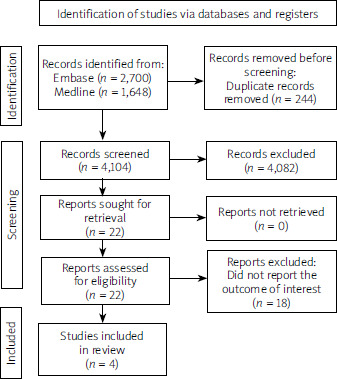
Figure 1

Study identification and literature review process

/f/fulltexts/PG/57776/PG-21-57776-g001_min.jpg
Table I

Baseline characteristics of all eligible studies included in the meta-analysis

ParameterStrate et al.Lin et al.
Year of publication20142015
Country of originDenmarkTaiwan
Study designRetrospective Cohort StudyRetrospective Cohort Study
Study participantsPatients were recruited from the Danish National Registry of Patients and the Civil Registration System from 1980 to 2011. Patients with a history of cardiovascular disease were excluded.Patients were recruited from the National Health Insurance Research Database in Taiwan from 2000 to 2011. Patients with a history of cardiovascular disease were excluded.
Number of participantsDiverticular group: 77,065.
Non-diverticular group: 302,572.
Diverticular group: 52,681.
Non-diverticular group: 210,724.
Diagnosis of diverticular diseaseDiverticular disease was identified by first inpatient or outpatient primary or secondary diagnosis of diverticular disease using ICD-8 to ICD-10 codes as a diagnosis.Diverticular disease was identified using ICD-9 codes as a diagnosis.
Diagnosis of myocardial infarctionMyocardial infarction was identified by ICD-8 to ICD-10 codes as a diagnosis, in which was diagnosed in all inpatient and outpatient hospital contacts.Myocardial infarction was identified by ICD-9 codes as a diagnosis, in which was diagnosed in all inpatient and outpatient hospital contacts.
Follow up timeUntil AMI event, or emigration, end of follow-up period (December 31st, 2011) or death.4.59 years.
Age84% more than 50 years of age.55.2 years.
GenderMale: 39%.Male: 56%.
Confounder adjusted in the multivariate analysisAge, sex, obesity, diabetes, hyperlipidaemia, COPD, renal failure, and connective tissue disease.Age, sex, diabetes mellitus, hypertension, hyperlipidaemia, stroke, chronic obstructive pulmonary disease, heart failure, chronic kidney disease, atrial fibrillation, cancer, liver cirrhosis, depression, autoimmune diseases, and alcoholism.
Newcastle-Ottawa scoreSelection: 4 stars.
Comparability: 2 stars.
Outcome: 3 stars.
Selection: 4 stars.
Comparability: 2 stars.
Outcome: 3 stars.
ParameterChen et al.Forss et al.
Year of publication20242024
Country of originUnited KingdomSweden
Study designProspective Cohort studyProspective Cohort study
Study participantsPatients were recruited from UK biobank cohort from 2006 to 2010. Patients with a history of cardiovascular disease were excluded.Patients were recruited from Swedish Epidemiology Strengthened by Histopathology Reports cohort and the National Patient Register from 1965 to 2017. Patients with a history of cardiovascular disease were excluded.
Number of participantsDiverticular group: 1190.
Non-diverticular group: 7172.
Diverticular group: 52,468.
Non-diverticular group: 194,525.
Diagnosis of diverticular diseaseDiverticular disease was identified by International Classification of Disease (ICD) codes with data from the nationwide inpatient dataset, primary care dataset, and cancer registries.Diverticular disease was identified by International Classification of Disease 8-10 (ICD) codes, as well as SNOMED codes, with data from the nationwide inpatient dataset and outpatient visits.
Diagnosis of myocardial infarctionMyocardial infarction was identified by ICD codes with diagnostic data from nationwide inpatient dataset and primary care dataset.Myocardial infarction was identified by ICD codes with diagnostic data from nationwide inpatient dataset and primary care dataset.
Follow up time12.4 years.8.6 years.
Age55 years.59 years.
GenderMale: 42%.Male: 38%.
ParameterChen et al.Forss et al.
Confounder adjusted in the multivariate analysisAge, sex, Townsend deprivation index, body mass index, education, ethnicity, smoking status, drinking status, physical activity, and adherence to a healthy diet.Age, sex, calendar year, county of residence, country of birth (Nordic country or other), educational level (co mpulsory school, upper secondary school, or college/university), ≥ 1 metabolic disease (diabetes, obesity, hypertension, and dyslipidaemia), chronic kidney disease, chronic obstructive pulmonary disease with diagnosis ≥ 40 years of age, and alcohol related disease.
Newcastle-Ottawa scoreSelection: 4 stars.
Comparability: 2 stars.
Outcome: 3 stars.
Selection: 4 stars.
Comparability: 2 stars.
Outcome: 3 stars.

A total of 4 cohort studies with 898,397 participants investigated the association between diverticular disease and AMI. The average participant age was 57 years, and 43% were male, as shown in Table I (Average participant age was utilised from 3 studies, except Strate et al. (2014) due to no mean age reported). The pooled analysis revealed that individuals with diverticular disease had an increased risk of myocardial infarction, with a pooled RR of 1.27 (95% CI: 1.17, 1.37; p < 0.001, Figure 2), when compared to individuals without diverticular disease. High statistical heterogeneity was observed (I2 = 83%). Of the 4 included studies, only one (Lin et al.) provided any stratification by diverticular disease subtype (diverticulosis vs. diverticulitis). The remaining studies combined the whole spectrum of diverticulosis into a pooled cohort. None of the studies provided sufficient data to perform subgroup analyses based on symptom status (symptomatic vs. asymptomatic). Furthermore, reporting of established cardiovascular risk factors (smoking, obesity, etc.) was inconsistent and incomplete across studies, precluding adjusted pooled analyses.
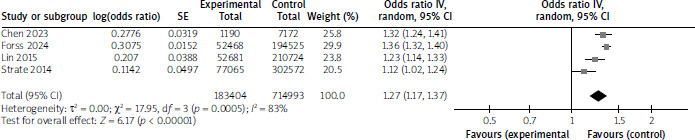
Figure 2

Forest plot of meta-analysis

/f/fulltexts/PG/57776/PG-21-57776-g002_min.jpg

A funnel plot evaluating publication bias for all studies shows no obvious asymmetry, suggesting no publication bias, as shown in Figure 3. Additionally, the Egger regression test (p = 0.800) confirms the absence of publication bias.
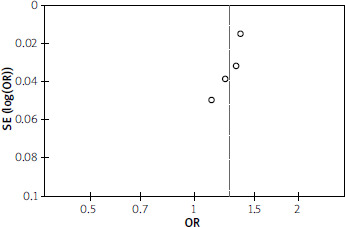
Figure 3

Funnel plot of meta-analysis

/f/fulltexts/PG/57776/PG-21-57776-g003_min.jpg

Discussion

This study is the first systematic review and meta-analysis to consolidate data on how diverticular disease affects the risk of incident AMI. The pooled analysis indicated that diverticular disease patients have 27% higher risk of an AMI event compared to individuals without diverticular disease.

Several explanations exist for our findings, despite the limited literature of the pathophysiological process behind diverticular disease and acute myocardial infarction. First, a gut-heart connection has been proposed via oxidative stress and ongoing inflammation process. Diverticular disease, in some of its spectrum, has been known to express tumour necrosis factor a (TNF-a) [22], as well as higher levels of C-reactive protein (CRP) and interleukin-6 (IL-6), pre-diagnostically [23]. TNF-a and IL-6 are directly linked to coronary artery disease and AMI events [24, 25], which may explain our results. In addition, persistent low-grade inflammation can occur up to 24 months after post-acute events of diverticular disease [26], and may generate inflammatory cytokines contributing to acute myocardial infarction subsequently. Interestingly, one of our selected studies performed a subgroup analysis [16], in which both diverticulosis and diverticulitis had statistically significant higher risk of AMI events, suggesting that any spectrum of diverticular disease had similar risk of AMI events. Finally, one study [14] indicated that diverticular disease had a higher risk of venous thromboembolism, and the concurrent of venous thromboembolism and diverticular disease could lead to higher risk of cancer [27] in this subpopulation group.

Increasingly, some studies have indicated changes of microbiota in patients with diverticular disease, compared to those without [2830]. The depletion of Clostridium cluster IV, Clostridium cluster IX, and Lactobacillaceae [28], in which there are anti-inflammatory producing species [31, 32], was reported when comparing between diverticular and non-diverticular disease groups. Clostridium cluster IX is known to produce propionate, which is associated with health-promoting effects including anti-lipogenic, cholesterol-lowering, anti-inflammatory, and anti-carcinogenic action [28]. Moreover, some pathogenic species, such as Fusobacteria, Prevotella, and Paraprevotella, are more abundant in the diverticular disease group [30]. Prevotella has shown to be related to colitis [33], whereas Fusobacterium is correlated with the pathogenesis of colorectal cancer through activation of host inflammatory responses [34]. With decreasing amounts of anti-inflammatory microbiota and increasing amounts of pathogenic microbiota, gut microbiome can be linked to the potential causes in our study [35].

Our study has several major advantageous. As the first study to investigate the current evidence of the relationship between diverticular disease and acute myocardial infarction events, the large population size facilitates precision and improves estimates of the effect size or association [36]. This review strictly adhered to recommendations from the PRISMA guidelines. Efforts were made to search grey literature with no language restrictions, reducing publication bias. However, the current meta-analysis has several limitations. Firstly, the included meta-analysis showed high heterogeneity, possibly influenced by differences in baseline characteristics such as prevalence of diverticular disease, characteristics of diverticular disease as defined by each author, and follow-up duration. Secondly, because all studies were conducted mainly on developed country populations, the findings may not be generalisable to other populations. Thirdly, as the original papers did not present detailed data of the patients, or fine differentiation between diverticular spectrum, subgroup analyses including smoking, obesity, diabetes, and others could not be done. Lastly, although the risk of AMI is increased by almost 30%, the role of acetylsalicylic acid in this patient group is currently unknown. Large studies aiming at benefit and risk, such as incidence of gastrointestinal bleeding, must be evaluated before a recommendation can be rendered.

Conclusions

Our meta-analysis found that diverticular disease was associated with a higher risk of AMI. Because diverticular disease is highly prevalent in the general population, understanding its mechanism and pathophysiology is crucial to reduce the incidence of AMI as well as improve long-term survival outcomes.

Funding

No external funding.

Ethical approval

Not applicable.

Conflict of interest

The authors declare no conflict of interest.

References

1 

Munie ST, Nalamati SPM. Epidemiology and pathophysiology of diverticular disease. Clin Colon Rectal Surg 2018; 31: 209-13.

2 

Strate LL, Morris AM. Epidemiology, pathophysiology, and treatment of diverticulitis. Gastroenterology 2019; 156: 1282-98.

3 

Peery AF, Crockett SD, Murphy CC, et al. Burden and cost of gastrointestinal, liver, and pancreatic diseases in the United States: update 2021. Gastroenterology 2022; 162: 621-44.

4 

Bharucha AE, Parthasarathy G, Ditah I, et al. Temporal trends in the incidence and natural history of diverticulitis: a population-based study. Am J Gastroenterol 2015; 110: 1589-96.

5 

Zuin M, Rigatelli G, Andreotti AN, et al. Could we consider diverticular disease as a non-traditional risk factor for coronary artery disease? Int J Cardiol 2016; 223: 649-50.

6 

Chen K, Wang YC, Yang KT, et al. Association of diverticulitis and potential risk of ischemic stroke: population-based matched cohort study in Taiwan. Postgrad Med J 2024; 100: 475-81.

7 

Joshi R, Chow CK, Raju PK, et al. Fatal and nonfatal cardiovascular disease and the use of therapies for secondary prevention in a rural region of India. Circulation 2009; 119: 1950-5.

8 

Sundaram V, Fang JC. Gastrointestinal and liver issues in heart failure. Circulation 2016; 133: 1696-703.

9 

Boersma E, Mercado N, Poldermans D, et al. Acute myocardial infarction. Lancet 2003; 361: 847-58.

10 

Chew NWS, Chong B, Kuo SM, et al. Trends and predictions of metabolic risk factors for acute myocardial infarction: findings from a multiethnic nationwide cohort. Lancet Reg Health West Pac 2023; 37: 100803.

11 

Liu PH, Cao Y, Keeley BR, et al. Adherence to a healthy lifestyle is associated with a lower risk of diverticulitis among men. Am J Gastroenterol 2017; 112: 1868-76.

12 

Strate LL, Liu YL, Aldoori WH, et al. Obesity increases the risks of diverticulitis and diverticular bleeding. Gastroenterology 2009; 136: 115-22.

13 

Tam I, Liu PH, Ma W, et al. History of diverticulitis and risk of incident cardiovascular disease in men: a cohort study. Dig Dis Sci 2022; 67: 1337-44.

14 

Strate LL, Erichsen R, Horváth-Puhó E, et al. Diverticular disease is associated with increased risk of subsequent arterial and venous thromboembolic events. Clin Gastroenterol Hepatol 2014; 12: 1695-701.

15 

Forss A, Ma W, Thuresson M, et al. Diverticular disease and risk of incident major adverse cardiovascular events: a nationwide matched cohort study. Eur Heart J Qual Care Clin Outcomes 2025; 11: 15-23.

16 

Lin JN, Lin CL, Yang CH, et al. Increased risk of acute coronary syndrome in patients with diverticular disease: a nationwide population-based study. Medicine 2015; 94: e2020.

17 

Chen J, Sun Y, Fu T, et al. Risk of incident cardiovascular disease among patients with gastrointestinal disorder: a prospective cohort study of 330 751 individuals. Eur Heart J Qual Care Clin Outcomes 2024; 10: 357-65.

18 

Erichsen R, Strate L, Sørensen HT, Baron JA. Positive predictive values of the International Classification of Disease, 10th edition diagnoses codes for diverticular disease in the Danish National Registry of Patients. Clin Exp Gastroenterol 2010; 3: 139-42.

19 

Hartling L, Hamm M, Milne A, et al. Decision rules for application of the Newcastle-Ottawa Scale. Agency for Healthcare Research and Quality 2012.

20 

Dersimonian R, Laird N. Meta-analysis in clinical trials. Control Clin Trials 1986; 7: 177-88.

21 

Higgins JP, Thompson SG, Deeks JJ, Altman DG. Measuring inconsistency in meta-analyses. BMJ 2003; 327: 557-60.

22 

Tursi A, Elisei W, Inchingolo CD, et al. Chronic diverticulitis and Crohn’s disease share the same expression of basic fibroblastic growth factor, syndecan 1 and tumour necrosis factor-a. J Clin Pathol 2014; 67: 844-6.

23 

Ma W, Jovani M, Nguyen LH, et al. Association between inflammatory diets, circulating markers of inflammation, and risk of diverticulitis. Clin Gastroenterol Hepatol 2020; 18: 2279-86.

24 

Szekely Y, Arbel Y. A review of interleukin-1 in heart disease: where do we stand today? Cardiol Ther 2018; 7: 25-44.

25 

Yuan S, Carter P, Bruzelius M, et al. Effects of tumour necrosis factor on cardiovascular disease and cancer: a two-sample Mendelian randomization study. Ebiomedicine 2020; 59: 102956.

26 

Tursi A, Elisei W. Role of inflammation in the pathogenesis of diverticular disease. Mediators Inflamm 2019; 2019: 8328490.

27 

Thomsen L, Troelsen FS, Nagy D, et al. Venous thromboembolism and risk of cancer in patients with diverticular disease: a Danish population-based cohort study. Clin Epidemiol 2021; 13: 735-44.

28 

Barbara G, Scaioli E, Barbaro MR, et al. Gut microbiota, metabolome and immune signatures in patients with uncomplicated diverticular disease. Gut 2017; 66: 1252-61.

29 

Daniels L, Budding AE, de Korte N, et al. Fecal microbiome analysis as a diagnostic test for diverticulitis. Eur J Clin Microbiol Infect Dis 2014; 33: 1927-36.

30 

Mj O, Turner GA, Sulit A, Frizelle FA, Purcell R. Distinct changes in the colonic microbiome associated with acute diverticulitis. Colorectal Dis 2022; 24: 1591-601.

31 

Dicksved J, Halfvarson J, Rosenquist M, et al. Molecular analysis of the gut microbiota of identical twins with Crohn’s disease. ISME J 2008; 2: 716-27.

32 

Rajilić-Stojanović M, Biagi E, Heilig HG, et al. Global and deep molecular analysis of microbiota signatures in fecal samples from patients with irritable bowel syndrome. Gastroenterology 2011; 141: 1792-801.

33 

Scher JU, Sczesnak A, Longman RS, et al. Expansion of intestinal Prevotella copri correlates with enhanced susceptibility to arthritis. Elife 2013; 2: e01202.

34 

Kelly D, Yang L, Pei Z. Gut microbiota, fusobacteria, and colorectal cancer. Diseases 2018; 6: 109.

35 

Flint HJ, Scott KP, Louis P, Duncan SH. The role of the gut microbiota in nutrition and health. Nat Rev Gastroenterol Hepatol 2012; 9: 577-89.

36 

Fagard RH, Staessen JA, Thijs L. Advantages and disadvantages of the meta-analysis approach. J Hypertens Suppl 1996; 14: S9-12.

Copyright: © 2026 Termedia Sp. z o. o. This is an Open Access article distributed under the terms of the Creative Commons Attribution-NonCommercial-ShareAlike 4.0 International (CC BY-NC-SA 4.0) License (http://creativecommons.org/licenses/by-nc-sa/4.0/), allowing third parties to copy and redistribute the material in any medium or format and to remix, transform, and build upon the material, provided the original work is properly cited and states its license.
 
© 2026 Termedia Sp. z o.o.
Developed by Termedia.